Stiffness can sneak up on you after a long workday, a crowded subway commute, a tough workout, or a weekend spent catching up on errands. Your neck feels locked, your low back takes a few extra seconds to straighten, and your hips or shoulders do not move the way they should.
The good news is that gentle movement can often help. If you are looking for chiropractic moves to do at home, the safest place to start is not with self-adjustments or forceful twisting. It is with simple mobility and activation exercises that help your spine and joints move through comfortable ranges.
These seven moves are designed for everyday stiffness, not for diagnosing or treating a serious injury. Use them as a practical reset between appointments, after sitting, or as part of a morning routine. If pain is sharp, worsening, or radiating into an arm or leg, stop and get evaluated.
Before You Start: What Chiropractic Moves Means at Home
At-home chiropractic moves are not the same as a chiropractic adjustment. A licensed chiropractor evaluates your history, joint movement, nerve symptoms, posture, strength, and pain triggers before deciding which hands-on techniques are appropriate. Trying to force your own neck or back to pop can irritate joints, strain tissues, or make symptoms worse.
For home care, think in terms of controlled mobility. The goal is to reduce guarding, improve circulation, restore comfortable range of motion, and remind stiff areas how to move again. These exercises should feel like gentle movement, not a test of flexibility.
This approach also fits with broader evidence-based guidance for many common spine-related aches. The American College of Physicians guideline recommends non-drug options such as exercise, superficial heat, spinal manipulation, and other conservative therapies for many adults with low back pain, depending on the situation.
A good rule: after these moves, you should feel the same or better. Mild stretching discomfort is acceptable. Sharp pain, numbness, dizziness, weakness, or symptoms that linger afterward are signs to stop.
Safety First: Do Not Stretch Through Red Flags
Stiffness is common, but some symptoms need medical attention before you try home exercises. Seek prompt evaluation if stiffness is linked to trauma, worsening nerve symptoms, unexplained illness, or a sudden major change in function.
Avoid these moves and contact a healthcare professional urgently if you have:
- New weakness, numbness, or tingling that spreads down an arm or leg
- Loss of bladder or bowel control, or numbness in the groin or saddle area
- Severe pain after a fall, accident, or sports collision
- Fever, chills, unexplained weight loss, or a history of cancer with new spine pain
- Sudden severe headache, dizziness, vision changes, or trouble speaking
- Chest pain, shortness of breath, or pain that feels unrelated to movement
If you are pregnant, recently had surgery, have osteoporosis, inflammatory arthritis, a known disc injury, or a complex medical history, ask your provider which movements are safe for you.
Quick Overview: 7 Moves for Everyday Stiffness
| Move | Best for | Time or reps |
|---|---|---|
| Supine pelvic tilts with breathing | Low back stiffness and morning tightness | 8 to 12 slow reps |
| Cat-cow | General spine mobility | 8 to 12 slow reps |
| Open-book rotation | Upper back and rib stiffness | 6 to 8 reps per side |
| Chin tucks | Neck tension and forward head posture | 8 to 10 reps |
| Wall slides | Shoulder and upper back stiffness | 6 to 10 reps |
| Half-kneeling hip flexor stretch | Tight hips from sitting | 30 to 45 seconds per side |
| Glute bridge | Low back support and hip activation | 8 to 12 reps |
1. Supine Pelvic Tilts With Breathing
This is one of the gentlest ways to wake up a stiff low back. It combines small spinal movement with relaxed breathing, which can help reduce muscle guarding after sleep or prolonged sitting.
Lie on your back with your knees bent and feet flat on the floor. Place one hand on your lower ribs and the other near your lower abdomen. Inhale through your nose and let your ribs expand gently. As you exhale, slowly tilt your pelvis so your low back flattens slightly toward the floor. Inhale and return to a neutral position.
Keep the movement small. You are not trying to press your back aggressively into the floor or lift your hips. Repeat 8 to 12 times at a slow pace.
This move is especially useful before getting out of bed, after a long meeting, or before doing more active mobility work.
2. Cat-Cow
Cat-cow helps the spine move through flexion and extension in a controlled, low-load position. It is a classic mobility drill for stiffness across the neck, mid-back, and low back.
Start on your hands and knees with your wrists under your shoulders and knees under your hips. As you inhale, gently let your belly move toward the floor while lifting your chest and tailbone. As you exhale, round your back upward, tuck your tailbone slightly, and let your head follow naturally.
Move slowly and stay within a comfortable range. If your wrists are uncomfortable, try placing your forearms on a bench or doing the movement with your hands on a countertop.
Repeat 8 to 12 times. The goal is smooth motion, not maximum arching or rounding.
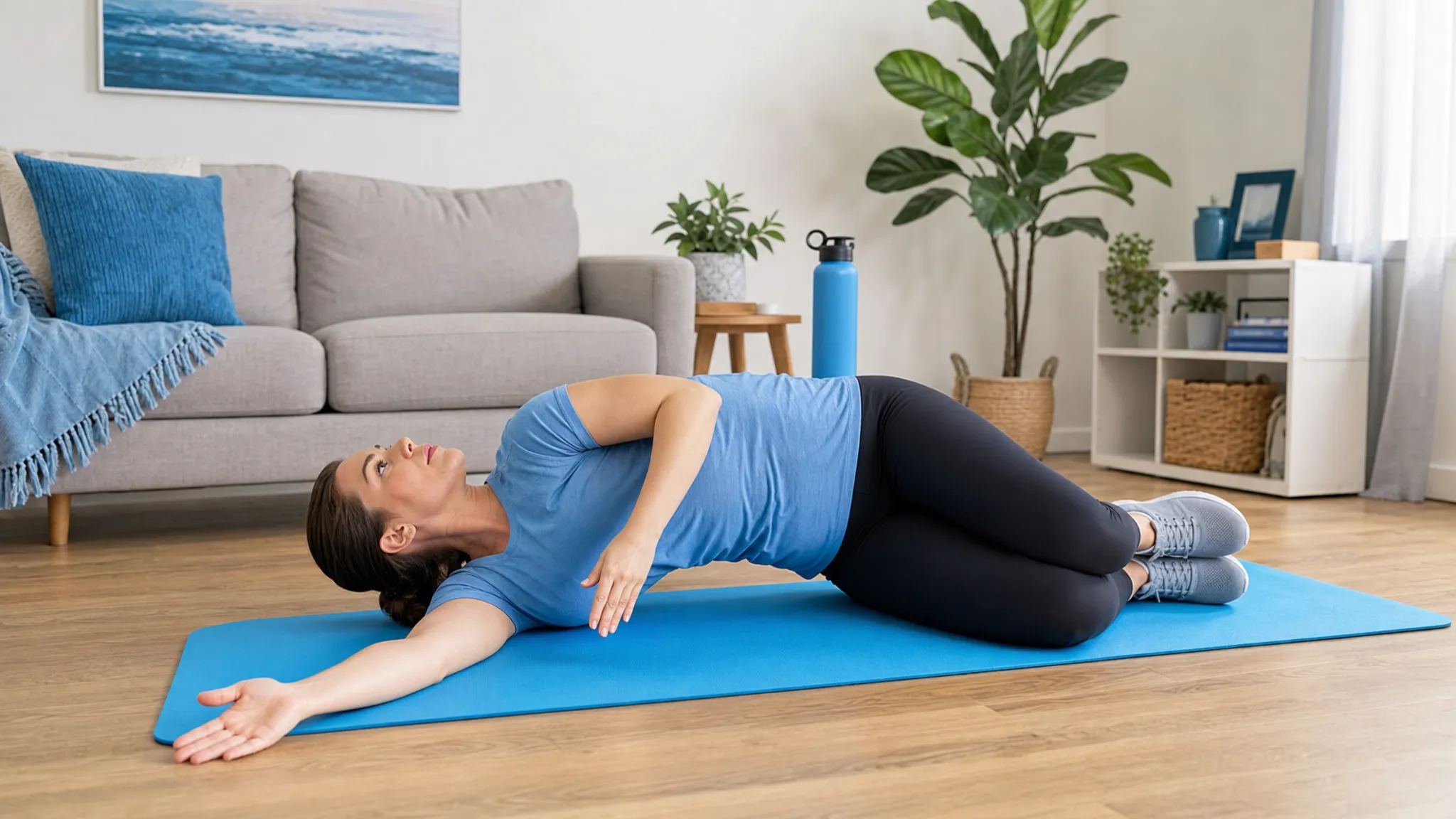
3. Open-Book Rotation
Many people feel stiff in the neck or low back when the real limitation is in the thoracic spine, the upper and mid-back area that connects to the ribs. Open-book rotations gently encourage rotation where many desk workers and commuters need it most.
Lie on one side with your knees bent and stacked. Extend both arms straight in front of your chest with palms together. Keeping your knees together, slowly rotate your top arm open toward the opposite side, letting your chest turn as far as comfortable. Pause for a breath, then return to the start.
Do 6 to 8 reps per side. Keep the movement easy and controlled. If the top shoulder does not reach the floor, that is fine. Do not force it.
This is a helpful move when your upper back feels locked, your shoulders feel rounded forward, or you notice yourself twisting from the low back instead of the rib cage.
4. Chin Tucks
Chin tucks can help with neck stiffness related to forward head posture, screen time, and long periods of looking down. They are subtle but powerful when done correctly.
Sit or stand tall. Imagine the back of your head sliding straight backward, as if you are making a double chin. Keep your eyes level and avoid looking down. Hold for 2 to 3 seconds, then relax.
Repeat 8 to 10 times. You should feel mild work in the deep front of the neck and a gentle lengthening at the base of the skull. If you feel pinching, dizziness, or increased symptoms, stop.
For an easier version, lie on your back with a small towel under your head and perform the same gentle sliding motion.
5. Wall Slides
Wall slides target the shoulders, shoulder blades, and upper back. They are especially useful if your stiffness comes with rounded shoulders, desk posture, or tightness across the chest.
Stand with your back near a wall, feet a few inches forward, and ribs relaxed. Bring your arms up against the wall in a goalpost shape if comfortable. Slowly slide your arms upward, then return to the starting position. Keep your motion smooth and avoid shrugging your shoulders toward your ears.
Do 6 to 10 reps. If the wall version feels too intense, perform the same motion lying on your back or standing without touching the wall.
This move should not cause shoulder pinching. If it does, reduce the range or skip it until you have guidance from a clinician.
6. Half-Kneeling Hip Flexor Stretch
Tight hip flexors are common in people who sit for long periods. When the front of the hips stays tight, the pelvis and low back may feel stiff, especially when standing up after sitting.
Start in a half-kneeling position with one knee on the floor and the other foot forward. Gently tuck your pelvis, as if bringing your belt buckle slightly upward. Keeping that position, shift your body forward just enough to feel a stretch in the front of the back hip.
Hold for 30 to 45 seconds per side while breathing slowly. Avoid arching your low back to chase a deeper stretch. The pelvic tuck is what makes this move effective.
If kneeling is uncomfortable, try a standing version with one foot behind you and the same gentle pelvic tuck.
7. Glute Bridge
Not all stiffness improves with stretching alone. Sometimes your body feels tight because key muscles are not doing enough work, so other areas compensate. Glute bridges help activate the hips and support the low back.
Lie on your back with knees bent and feet hip-width apart. Lightly brace your abdomen, press through your heels, and lift your hips until your body forms a straight line from shoulders to knees. Pause briefly, then lower with control.
Do 8 to 12 reps. You should feel the glutes working more than the low back or hamstrings. If your low back cramps or pinches, lower the height and focus on squeezing the glutes before lifting.
This is a good finishing move after mobility work because it reinforces stability after you create movement.
How to Build a Simple Routine
You do not need to do all seven moves every time. The best routine is the one you can repeat consistently without irritating symptoms. Start with 5 to 10 minutes, then adjust based on how your body responds.
| Situation | Try these moves | Suggested time |
|---|---|---|
| Morning stiffness | Pelvic tilts, cat-cow, hip flexor stretch | 5 to 7 minutes |
| Desk break | Chin tucks, wall slides, open-book rotation | 3 to 5 minutes |
| After a workout | Cat-cow, open-book rotation, glute bridge | 5 to 8 minutes |
| Evening wind-down | Pelvic tilts with breathing, open-book rotation | 5 minutes |
If you sit most of the day, short movement breaks often work better than one long stretch session at night. A few minutes every couple of hours can help your joints and muscles avoid the same fixed position for too long. For more simple lifestyle ideas, see Move Well MD's guide to daily habits for less pain.
Common Mistakes to Avoid
The first mistake is chasing a pop. A joint sound is not the same as improved function, and repeatedly forcing your neck or back to crack can increase irritation. Focus on comfortable motion and better control instead.
The second mistake is stretching too aggressively. Stiffness often involves protective muscle tension. If you push hard, your nervous system may respond by tightening more. Gentle, repeated movement usually works better than forcing an end range.
The third mistake is doing only mobility and never strength. If stiffness keeps returning, your body may need more support from the core, glutes, upper back, or deep neck muscles. That is why a move like the glute bridge belongs in a stiffness routine.
The fourth mistake is ignoring your environment. If you stretch for 10 minutes but spend the next 8 hours hunched over a laptop, symptoms may return quickly. Chair height, screen position, walking breaks, sleep posture, and training load all matter.
When Home Moves Are Not Enough
Home mobility can be very helpful for mild stiffness, but it has limits. If your stiffness lasts more than 1 to 2 weeks, keeps coming back, interferes with sleep, limits work or exercise, or is paired with pain traveling into the arm or leg, it is time for a professional evaluation.
A chiropractor can assess whether your stiffness is related to joint restriction, muscle imbalance, posture habits, nerve irritation, prior injury, or another cause. Depending on your needs, care may include chiropractic treatment, soft tissue work, corrective exercise, physical therapy, acupuncture, or pain management support.
Move Well MD uses an integrated approach to pain relief and mobility, combining chiropractic care, acupuncture, physical rehabilitation, sports medicine, and pain management services when appropriate. If you are unsure whether stiffness needs professional attention, this guide on when to see a spine chiropractor for ongoing pain can help you decide.
Frequently Asked Questions
Are chiropractic moves to do at home the same as a chiropractic adjustment? No. At-home moves are mobility and strengthening exercises. A chiropractic adjustment is a hands-on clinical technique performed after an evaluation by a licensed provider. Do not try to force your own spine to adjust.
How often should I do these moves for stiffness? Many people do well with 5 to 10 minutes daily, especially after waking up or after long periods of sitting. Start slowly and see how your body responds.
Should these exercises hurt? No. Mild stretching or muscle effort is normal, but sharp pain, burning, numbness, tingling, dizziness, or worsening symptoms are not. Stop the movement and seek guidance if that happens.
Can these moves help stiffness from desk work? They may help reduce stiffness related to prolonged sitting and screen posture, especially when combined with movement breaks and better workstation habits. If symptoms persist, a chiropractor or physical therapist can help identify the underlying cause.
What if one side feels much tighter than the other? Mild asymmetry is common, but a major difference, pain, weakness, or symptoms traveling down one side should be evaluated. Do not force the tighter side to match the other.
When should I see a professional instead of relying on home exercises? Book an evaluation if stiffness is persistent, worsening, linked to an injury, affecting sleep, limiting daily activity, or associated with radiating pain, numbness, or weakness.
Get Personalized Help for Stiffness in Manhattan
These home moves are a smart place to start, but recurring stiffness often needs a plan built around your body, your workday, and your activity goals. If you want help understanding why you feel tight and what to do next, Move Well MD offers personalized chiropractic care and integrated pain relief services in Manhattan.
Schedule a visit with Move Well MD to get evaluated and build a care plan that helps you move more comfortably and confidently.
