Choosing a chiropractor can feel surprisingly high-stakes. When you are in pain, the difference between the right provider and the wrong one shows up in your body, your schedule, and often your wallet. That is why people search for a “recommended chiropractor” and then rely heavily on online reviews.
Reviews can be useful, but only if you know how to read them. Below is a practical, evidence-based way to vet chiropractic reviews so you can book with more confidence and fewer surprises.
Step 1: Start with what reviews cannot prove (licensure and scope)
Before you interpret a single five-star rating, confirm the basics that reviews are not designed to validate.
Verify the chiropractor is licensed in New York
In New York State, chiropractors are licensed professionals. You can verify a license through the New York State Education Department (NYSED) Office of the Professions online verification system: NYSED Office of the Professions license verification.
This step matters because:
- A high rating does not confirm current licensure.
- A clinic name on Google may not clearly identify the treating chiropractor.
- Some reviews describe an office experience, not the credentials of the person delivering care.
Look for clear, ethical boundaries in how the clinic talks about care
A trustworthy provider typically describes what they treat in grounded terms (pain, mobility, function), and will refer out when appropriate.
Be cautious if the clinic’s marketing or reviews repeatedly suggest chiropractic “cures” for unrelated diseases. Reviews can amplify exaggerated claims because satisfied patients often repeat what they were told.
Step 2: Use a “review triangulation” method, not one platform
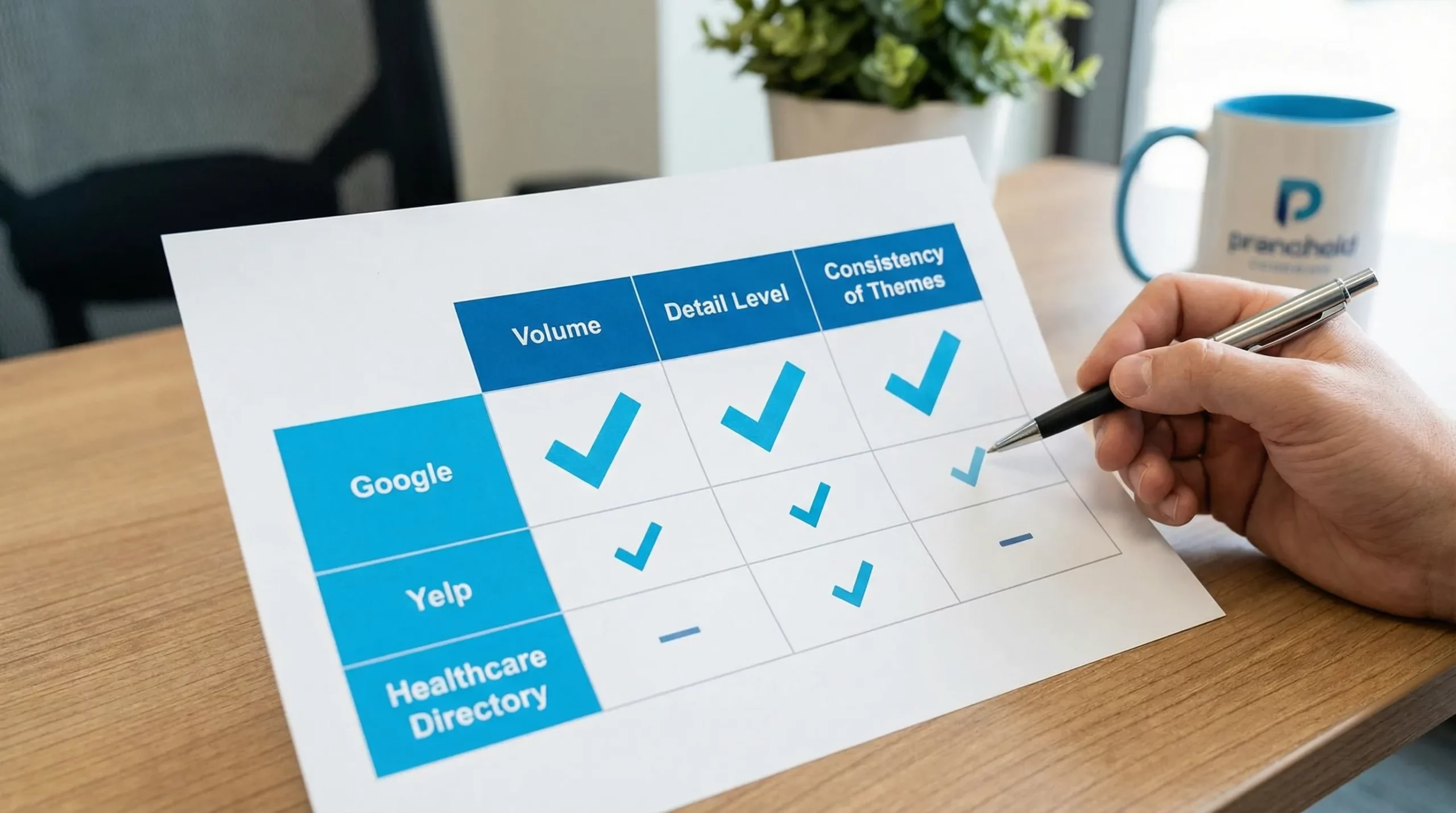
A clinic’s online reputation can look very different depending on where you read it. For a recommended chiropractor, aim to compare at least two to three sources.
Common platforms include:
- Google Business Profile (high volume, easier to post, higher risk of low-detail reviews)
- Yelp (more aggressive filtering, sometimes fewer reviews)
- Healthcare directories (for example Healthgrades or Zocdoc, where applicable)
What you are looking for is not perfection across platforms. You are looking for consistency in the themes: communication, outcomes, professionalism, and billing transparency.
Step 3: Read reviews for clinical “signal,” not just sentiment
Most people scan for star ratings, but the most useful information is in the specifics. When a review is genuinely informative, it often includes context that is hard to fake.
High-signal details to look for
A credible review often mentions:
- The patient’s main complaint (for example low back pain, neck pain, sciatica symptoms, headaches)
- What evaluation felt like (history, exam, referral advice)
- What treatment included (for example spinal manipulation, mobilization, soft tissue work, rehab exercises, acupuncture as a complement)
- How progress was tracked (function, range of motion, tolerance to activity, symptom changes)
- Any expectations set (how many visits might be needed, what “normal soreness” might feel like)
A low-information review often stays vague: “Amazing!!! Life-changing!!!” with no detail.
A useful rule: outcomes should be described as functional
Pain scores matter, but function is harder to exaggerate. Strong reviews often describe measurable daily-life improvements such as:
- “I can sit through work meetings again without numbness.”
- “I returned to running without my symptoms flaring.”
- “Sleeping is easier because my neck is not waking me up.”
These are more meaningful than generic claims.
Step 4: Know the patterns of fake, filtered, or incentivized reviews
Fake reviews are not just an annoyance, they can push you toward a clinic that is good at marketing instead of good at care.
In 2024, the U.S. Federal Trade Commission finalized a rule targeting fake reviews and testimonials, including certain forms of review manipulation and insider reviews. You can read the FTC announcement here: FTC: rule on consumer reviews and testimonials.
Common review red flags
- Timing spikes: dozens of reviews posted within a few days, then long gaps.
- Same writing style: repetitive phrasing across different accounts.
- Overly broad miracle language: claims that sound like marketing copy.
- No negatives at all: even excellent clinics usually have at least a few mixed experiences.
- Reviewer profiles look empty: brand-new accounts with only one review.
What is not automatically a red flag
- A clinic asking for feedback in general (ethical offices often do this).
- A clinic with some short reviews (busy New Yorkers write fast).
The goal is to identify patterns that make the overall rating unreliable.
Step 5: Separate “front desk reviews” from “care delivery reviews”
Some of the most intense reviews, both positive and negative, focus on office logistics:
- Wait times
- Scheduling
- Staff friendliness
- Paperwork
Those are relevant, but they are not the same as care quality.
When evaluating a recommended chiropractor, categorize reviews into two buckets:
| Review topic | What it can tell you | What it cannot tell you |
|---|---|---|
| Scheduling, wait time, staff | Operational reliability, patient flow | Whether treatment is appropriate or effective |
| Bedside manner, communication | How safe and respected you may feel | Whether the plan matches your condition |
| Clinical approach (exam, plan, exercises) | How thorough and individualized care may be | Your exact outcome (your case may differ) |
| Billing and insurance | Transparency, predictability of costs | Whether your insurer will process your claim the same way |
A clinic can be warm and efficient but still deliver cookie-cutter care. The reverse can also be true.
Step 6: Watch for review language that suggests overtreatment
One of the most important “between the lines” signals is how the plan of care is described.
Be cautious if many reviews imply:
- Pressure to prepay large packages without a clear re-evaluation point
- A one-size-fits-all schedule (for example, “everyone needs 3x/week forever”)
- Fear-based messaging (“if you stop, your spine will collapse,” etc.)
A more reassuring pattern is when patients describe a plan that evolves, with check-ins and home care.
Step 7: Match reviews to your specific problem (and your preferences)
A recommended chiropractor for sports injuries is not always the best fit for migraines, pregnancy-related pelvic pain, or chronic desk-posture issues.
When scanning reviews, filter mentally for people who sound like you:
- Similar age range or activity level
- Similar work demands (desk work, lifting, commuting)
- Similar condition (neck pain, low back pain, radiating symptoms, joint pain)
- Similar goals (returning to sport vs reducing flare-ups vs improving posture)
Also consider your care preferences. Some clinics emphasize hands-on adjustments. Others integrate acupuncture, physical therapy, rehabilitation, and sports medicine services under one roof. Reviews often reveal which style you are actually signing up for.
Step 8: Cross-check reviews with “objective trust signals”
Think of online reviews as subjective data. Balance them with objective signals.
Trust signals worth checking
- Clear provider identities: the treating clinicians are named, not just “our team.”
- Transparent services: the clinic explains what they offer (for example chiropractic care, acupuncture, pain management, rehabilitation) without making unrealistic promises.
- A coherent clinical process: intake, exam, plan, re-evaluation.
- Professional presence: not flashy, just clear, consistent information.
If you are dealing with low back pain, it may help to know that major guidelines have recommended non-drug options as initial approaches, including spinal manipulation for some patients. For example, the American College of Physicians guideline (published in Annals of Internal Medicine) includes spinal manipulation among options for acute, subacute, and chronic low back pain depending on presentation and patient preference: ACP guideline on noninvasive treatments for low back pain.
The point is not that every chiropractor is right for every back pain case, it is that a reputable chiropractor should be able to explain when care is appropriate and when it is not.
Step 9: Use one appointment to validate what reviews claim
A first visit is where you confirm whether the online reputation matches reality.
Questions that help you vet care quality quickly
Ask questions that force specificity and clinical reasoning:
- “What do you think is driving my symptoms, and what makes you think that?”
- “What would be a normal response after treatment, and what would be a red flag?”
- “How will we measure progress in a way that is not just pain today versus pain tomorrow?”
- “If I do not improve in a few visits, what is your next step?”
Good answers are clear, structured, and not defensive.
Pay attention to informed consent and comfort
Reviews might say “the adjustment helped,” but your safety experience matters. You should feel that:
- Procedures are explained before they happen.
- You can opt out of any technique.
- Your questions are welcomed.
Step 10: Don’t ignore the money side of “recommended”
In NYC, cost and coverage can vary widely even among highly rated clinics. Reviews often mention surprise bills, unclear copays, or confusing package pricing.
To reduce cost stress, do two things:
Confirm financial expectations before ongoing care
Ask for clarity on:
- The price of an initial visit versus follow-ups
- Any additional services that may be recommended (for example acupuncture, rehab, injections) and whether they are optional
- Cancellation and late policies
Track your health spending during a treatment plan
When you are comparing options, it helps to see your total out-of-pocket costs across a month or quarter, not just the price per visit. If you want a simple way to organize that, a free expense tracker and budgeting app like MoneyPatrol can help you monitor healthcare spending alongside the rest of your budget.
This is especially useful if you are balancing chiropractic care with other needs like physical therapy, imaging, or gym and recovery expenses.
A quick scoring system you can use (without overthinking it)
If you want a simple way to decide whether reviews support choosing a recommended chiropractor, score the clinic in four categories from 0 to 2.
| Category | 0 points | 1 point | 2 points |
|---|---|---|---|
| Consistency across platforms | Big discrepancies | Mostly consistent | Highly consistent themes |
| Review detail | Mostly vague praise | Some detailed stories | Many specific, case-based reviews |
| Ethics signals | Pressure tactics described | Neutral | Clear, patient-centered language |
| Logistics and billing | Frequent complaints | Mixed | Repeated praise for clarity |
A total of 6 to 8 suggests the reviews are probably a reliable input, then your consult becomes the deciding factor.
If you are looking for integrated care in Manhattan
Some New York patients want more than spinal adjustments alone, especially for complex pain patterns involving posture, overuse, sports injuries, or nerve-related symptoms. In those cases, consider clinics that can coordinate multiple conservative options (for example chiropractic care, acupuncture, physical therapy, and pain management) under one roof.
If you want an example of what integrated, movement-focused care can look like in Lower Manhattan, you can explore Move Well MD here: Move Well MD. (As with any clinic, use the steps above to compare reviews and confirm fit during a first visit.)
Bottom line: reviews should reduce risk, not replace judgment
Online reviews are best used as a screening tool. They can help you avoid obvious problems and identify clinics that communicate well, run on time, and have patients with similar issues who improved.
But a truly recommended chiropractor is not just highly rated. They are licensed, transparent, evidence-aware, and willing to tailor care to your goals, then re-evaluate when the plan needs to change.
