Medically reviewed by Ben Gruen, DC, Chiropractor
A pain diary helps your treatment team understand what happens between appointments: when symptoms appear, which activities become difficult and how you respond to care. You do not need to document every sensation or write a lengthy daily report. A few consistent details can make your next conversation more useful than trying to remember whether your back felt better last Tuesday.
The goal is better treatment decisions, not perfect recordkeeping. This guide gives you a manageable routine, a copyable example and a way to turn daily notes into questions your chiropractor, physical therapist or other treating clinician can address.
Start with one goal and a manageable schedule
Before you begin, choose something pain currently makes difficult. For a Manhattan commuter, that might be standing on the subway, climbing apartment stairs or walking to work. Someone with shoulder pain might want to reach a kitchen shelf or sleep comfortably on either side.
Write that goal at the top of your notes. It keeps the record connected to your life rather than focused only on discomfort.
A practical starting point is one brief entry at roughly the same time each day for one to two weeks, unless your clinician recommends a different schedule. Add a short extra note for a significant flare, a new symptom or an unexpected treatment reaction. Do not postpone an appointment just to collect more entries.
Keep the routine short enough to maintain. If detailed tracking makes you anxious or overly focused on symptoms, simplify it and tell your clinician. Constant monitoring is not necessary to produce useful information.
What to put in a pain diary
The most helpful entries connect symptoms with function, context and treatment timing. Use the same basic fields each day so your team can compare like with like.
Location, sensation and a consistent pain rating
Describe where you feel pain and whether it travels. “Right low back, sometimes into the buttock” is more informative than “back hurts.” Words such as aching, burning, sharp or throbbing can help describe the experience, but they do not establish a diagnosis.
Record numbness, tingling or weakness separately. Those symptoms should not disappear inside a single pain score, and new or worsening neurological symptoms may need prompt assessment.
If you use a 0-to-10 scale, define 0 as no pain and 10 as the worst pain you can imagine. Label what you are rating: pain right now, average pain today or worst pain today. Choose a measure you can use consistently rather than switching between them without explanation.
Your rating is personal. A 5 for you does not have to match someone else's 5, and you do not need to defend the number.
Activity, sleep and everyday function
Pair the rating with one concrete activity. “Walked for 12 minutes before needing a break” gives your team more to work with than “walking was bad.” Other useful measures include how long you can sit, whether you can dress independently or how often discomfort wakes you.
Briefly note unusual circumstances, such as a long train ride, extra lifting, poor sleep or a stressful workday. These are possible contributors to discuss, not proof of what caused the pain. Stress-related changes do not make pain imaginary.
Try to record ordinary and better days too. If you only document flares, the diary can give an incomplete picture of your week.
Avoid adding so many variables that the routine becomes a burden. Start with your chosen activity goal and one or two contextual details that seem relevant. Your clinician can suggest additional fields if they would change treatment decisions.
Treatments, timing and unwanted effects
Record what you tried and when. This might include a prescribed exercise session, chiropractic care, acupuncture, a medication or a change in activity. For medication, note the name, dose actually taken and time, following your prescription or label instructions.
Describe the response at a clear interval: “Pain was 5 before the exercises and 4 about an hour later.” Include whether movement became easier and whether any benefit lasted into the next day.
Also document unwanted effects, such as dizziness, nausea, unusual soreness or skin irritation. Do not change medication doses or repeat a treatment simply to test a diary pattern. Ask your treating clinician about adjustments.
When several treatments occur on the same day, record them without trying to assign credit. A symptom change after a session is useful information, but timing alone cannot prove which treatment helped or whether the change would have happened anyway.
A copyable diary template with a realistic example
Use the fields below in a notebook, a private digital document or a tool recommended by your care team. The example is fictional and illustrates recordkeeping, not a treatment recommendation.
| Field | Example entry |
|---|---|
| Date and time | Monday, 7 p.m. |
| Location and sensation | Aching in the right low back; no new numbness or tingling |
| Pain rating | Current: 4/10. Worst today: 6/10 after a long seated train ride |
| Activity and function | Walked 12 minutes before taking a break; goal is a comfortable 20-minute walk |
| Relevant context | Slept about 6 hours; sat for roughly 90 minutes without changing position |
| Treatment or self-care | Completed the prescribed home exercises at 6 p.m.; otherwise kept the usual routine |
| Response and unwanted effects | Pain was 5/10 before the exercises and 4/10 at 7 p.m.; no unwanted effects noticed |
| Question for the team | Should I adjust how often I interrupt long periods of sitting? |
Not every field needs a full sentence. “No change” is enough when that is accurate. If you did not check something, leave it blank or write “not recorded” rather than guessing.
This entry gives the clinician several discussion points, but it does not prove that sitting caused the flare or that the exercises caused the lower score.
Paper or app? Choose convenience and privacy
The best format is one you can use consistently and bring to an appointment. Paper works well if you prefer writing. A phone note may be easier during a commute, provided you can protect access to the device and find the entries later.
Before using an app, check whether you can export your notes, what information it collects and whether it shares data with third parties. Avoid putting identifying details into a tool simply because it offers a convenient text box.
Website chats can serve very different purposes. For example, Nudge's B2B website conversation and meeting-booking tools support sales conversations, not personal pain records. A chat invitation is not, by itself, a clinical intake channel. Ask your treatment team where to send sensitive health information and whether they want the full diary or a summary.
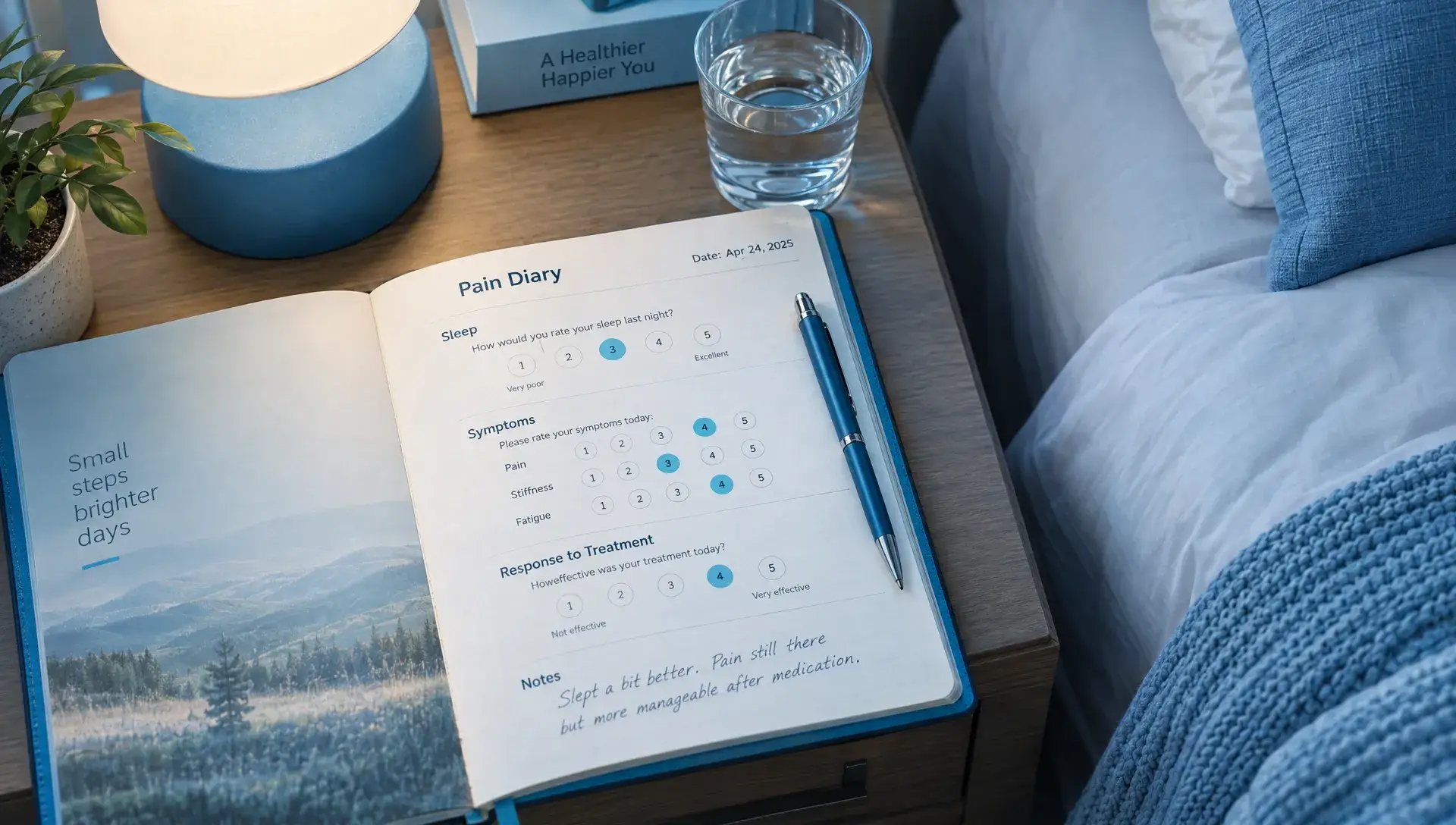
Turn your notes into a useful appointment summary
Bring the original entries, but start the visit with a short summary. Your team should be able to understand the main changes without reading every line first.
A useful summary answers four questions:
- What changed? Describe whether symptoms, activity tolerance or sleep improved, worsened or stayed similar.
- What pattern repeated? Mention a recurring association, such as symptoms after long seated commutes, without presenting it as a confirmed cause.
- What happened after treatment? Note the timing, duration of benefit and any unwanted effects.
- What decision do you need help with? Ask about exercise progression, medication concerns, treatment frequency or whether a new symptom needs evaluation.
For example: “My evening pain score stayed around 4, but I can now walk 18 minutes instead of 10. Sitting through my commute is still difficult. I would like to know whether to progress my walking goal and how to manage the train ride.”
If you see more than one clinician, bring the same summary to each and ask how relevant updates should be shared. This can support coordination without assuming everyone has access to the same records.
For ongoing chiropractic treatment, these notes also support a more specific conversation about evaluating progress during care.
Look for meaningful change, not just lower numbers
Pain intensity is only one measure of progress. A lower score may not represent improvement if you achieved it by avoiding nearly all activity. Conversely, the same score may accompany better sleep, longer walks or greater independence.
Compare several similar days rather than treating one unusually good or difficult day as the whole story. Try to keep the context visible: walking farther may temporarily change symptoms, while a quiet weekend may reduce discomfort without showing how you manage a normal workday.
Ask your team to define what meaningful improvement would look like for your situation and when to reassess. That might include reaching a functional goal, tolerating rehabilitation better or reducing disruptive flares. There is no single diary score that determines whether a treatment is right for everyone.
If several approaches are involved, understanding when an integrated pain clinic may be useful can help you prepare questions about coordination. The diary supports that conversation; it does not replace an examination or establish a diagnosis.
Symptoms that should not wait for a diary review
Do not wait for your next scheduled visit to report a potentially urgent change. For back pain, new difficulty urinating, loss of bladder or bowel control, numbness around the groin or rapidly worsening leg weakness requires emergency evaluation.
New severe back pain with fever, pain after a significant injury or new neurological symptoms also warrants prompt medical assessment. MedlinePlus guidance on back pain explains warning signs that need medical attention.
Call 911 for possible emergencies such as chest pain, stroke symptoms or a sudden, extremely severe headache. Do not use a diary, an app or an online message to decide whether to delay emergency care.
Recording when a symptom started can help the evaluating team, but getting care comes first.
Frequently asked questions
Should I record pain-free days? Yes. Note what you could do comfortably and whether your routine was typical. Better days help your team see the full pattern rather than only the difficult periods.
What if I forget to make an entry? Resume with the next scheduled entry. You can add a brief recollection if you label it as an estimate, but do not invent precise scores or times to fill a gap.
Can a pain diary tell me whether I need imaging? No. It may help describe symptom duration, changes and functional limitations, but decisions about imaging depend on your history, examination findings and other clinical factors.
Should I track symptoms all day? Usually, a brief scheduled entry is more manageable than constant checking. Ask your clinician whether an additional entry around a particular activity or treatment would answer a specific question.
Bring a clearer picture to your next visit
Start with one functional goal, one consistent daily check-in and a short question for your team. You can add detail later if it helps guide a decision.
Move Well MD provides chiropractic care, acupuncture, physical therapy and pain management in Manhattan. When you contact Move Well MD, ask how to share your notes before or during an appointment. A concise record can help keep the discussion focused on what has changed, what remains difficult and what to consider next.
