Tight hips and low back pain often travel together. You might feel “stuck” getting out of a chair, notice stiffness after a run, or wake up with an achy low back that seems to come from nowhere. In many cases, the problem is not just the spine or just the hips, it is how the pelvis, hips, and low back share load.
That is where chiro massage therapy can be especially useful. When joint motion (chiropractic) and soft tissue tone (massage and manual therapy) are addressed together, many people find they can move more freely, tolerate exercise better, and stop triggering the same flare-ups.
Why tight hips can show up as low back pain
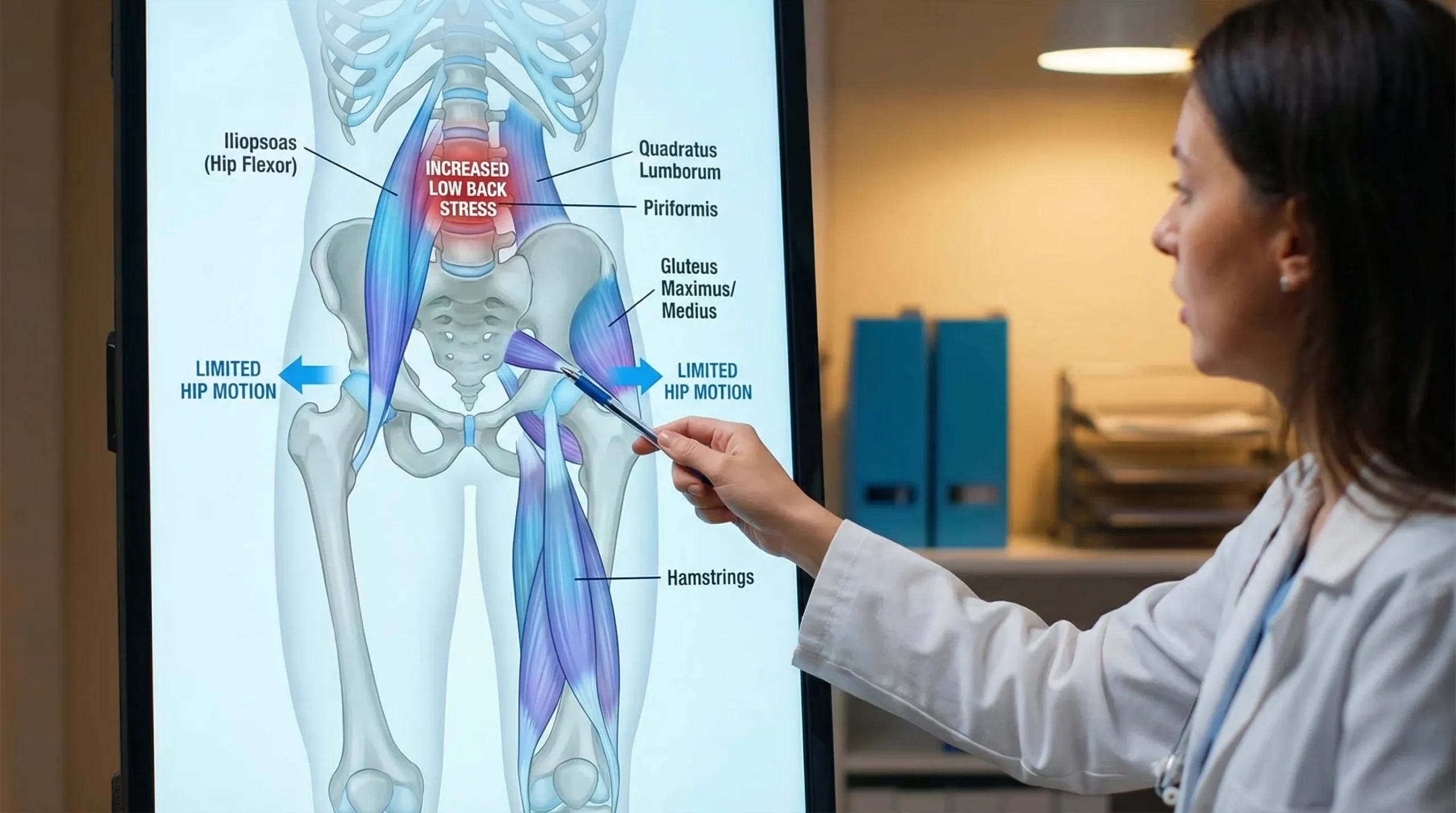
Your hips are designed for powerful movement: walking, squatting, climbing stairs, hinging, rotating. When hip motion is limited, the body still has to get you through daily life, so it “borrows” motion from somewhere else, often the lumbar spine.
Common examples:
- Limited hip extension (often from prolonged sitting) can force the low back to extend more when you stand, walk fast, or run.
- Limited hip rotation can make your low back and sacroiliac region compensate during turns, getting in and out of cars, or sports.
- Glute weakness or poor timing can shift work to the low back, hamstrings, or hip flexors.
A well-known posture and movement pattern related to this is “lower crossed syndrome,” where hip flexors and low-back extensors tend to be overactive while glutes and deep abdominals under-contribute. The key point is not labels, it is that muscles and joints adapt to what you do most. Desk work, long commutes, high training volume, or stress-driven bracing can all reinforce stiffness and pain.
What “chiro massage therapy” means in practice
People use the phrase chiro massage therapy to describe coordinated care that combines:
- Chiropractic assessment and adjustments to improve joint motion (commonly in the lumbar spine, pelvis, and sometimes the thoracic spine or hips).
- Soft tissue work (massage, trigger point work, myofascial techniques, instrument-assisted work, or stretching) to reduce excessive tone, calm irritated tissue, and improve tissue glide.
- Rehab guidance (mobility drills, strengthening, movement retraining) so the improvements hold when you return to sitting, workouts, and daily activities.
This “joint plus tissue plus movement” model matters because tight hips and low back pain are rarely a single-structure issue.
What the research says about manual care for low back pain
Low back pain is one of the most common musculoskeletal problems worldwide, and most cases are classified as “non-specific,” meaning no fracture, infection, cancer, or other serious cause is found.
Clinical guidelines often recommend conservative, non-drug options early, especially for acute and subacute low back pain. For example, the American College of Physicians (ACP) guideline on noninvasive treatments includes options such as spinal manipulation and massage among recommended approaches for certain patients, alongside exercise and other conservative therapies (ACP guideline).
The practical takeaway: manual therapies are not magic, but they can be an appropriate part of a plan, particularly when they help you move better and re-engage strength and activity.
The most common “tight hip” patterns that feed low back pain
“Tight hips” can mean different things depending on which tissues are stiff, overworked, or sensitive. Here are patterns clinicians frequently see, and how combined care may be targeted.
| Pattern (common driver) | What it often feels like | Why the low back gets involved | What combined care may focus on |
|---|---|---|---|
| Hip flexor dominance (iliopsoas, rectus femoris) | Pinchy front-of-hip, stiffness when standing up, arching low back | Reduced hip extension leads to lumbar extension compensation | Soft tissue to hip flexors plus pelvic and lumbar mechanics, then glute activation and hip extension control |
| Deep glute overload (piriformis, deep rotators) | Buttock tightness, pain with long sitting, symptoms down the leg in some cases | Hip rotation limitations shift load to lumbar spine and SI region | Soft tissue to glutes/rotators, mobility for hip rotation, nerve sensitivity screening, gradual loading |
| Lateral hip tightness (TFL, glute med, IT band region) | Outer-hip soreness, hip fatigue with walking, “tight band” feeling | Pelvic control issues can increase lumbar side-bending load | Tissue work laterally, hip stability, gait mechanics, core endurance |
| QL and paraspinal overwork | One-sided low back tightness, hard to stand tall after sitting | Trunk muscles do the job hips/glutes should share | Spinal and pelvic joint work, QL/low back soft tissue, re-training hinge and bracing patterns |
| Adductor and pelvic floor guarding (varies) | Inner thigh tightness, groin discomfort, “stiff pelvis” | Guarding changes pelvic motion and breathing mechanics | Careful assessment, graded mobility, breath mechanics, referral if needed |
A high-quality exam matters here because different patterns can feel similar. For example, “hip tightness” could be true muscle stiffness, joint restriction, tendon irritation, or even referred pain.
How chiropractic and massage can complement each other for tight hips and low back
A simple way to think about it is sequencing.
Massage and soft tissue work: reduce the “noise”
When tissue is guarded or painful, the nervous system often turns the volume up. Soft tissue therapy can:
- Decrease protective muscle tone that limits motion
- Improve tolerance to stretching and strengthening
- Help you feel where you are holding tension (so you can change it)
Chiropractic care: restore motion and reduce joint stress
If a joint is not moving well (lumbar segments, sacroiliac joint, pelvic mechanics, sometimes hip joint mobility), targeted chiropractic techniques may:
- Improve mobility in restricted areas
- Reduce mechanical irritation from repeated compensation
- Make it easier to achieve a more neutral posture and smoother gait
Rehab and movement retraining: keep the gains
Relief that does not translate into better movement often fades. The goal is to convert “I feel looser” into “I move differently,” with simple progressions that match your life (desk work, parenting, training, performance goals).
What to expect at a chiro massage therapy visit for tight hips and low back
While each clinic has its own flow, evidence-based conservative care typically includes:
- History and goal-setting: when symptoms started, what triggers them, what you need to do (sit, commute, lift, run, sleep).
- Screening for red flags: signs that you need imaging or medical referral.
- Physical exam: hip range of motion, lumbar motion, neurological screen if needed (strength, reflexes, sensation), gait or squat/hinge assessment.
- Treatment plan: a combination of manual care plus a small set of home exercises that match your findings.
It is also normal to discuss what you might feel afterward. Some people feel immediate relief, others feel “worked” or mildly sore for 24 to 48 hours, especially after deeper soft tissue work.
At-home strategies that pair well with in-office care
If your hips and low back are irritated, the goal is not to stretch aggressively and hope. Start with positions and drills that reduce threat, then add strength.
1) 90/90 breathing to reduce pelvic bracing
Lie on your back with your feet on a chair (hips and knees about 90 degrees). Breathe slowly through the nose, exhale fully, and feel the ribs come down. Many people with tight hips and low back pain live in a constant “arched and braced” pattern, and breathing is a simple way to change that.
2) Hip flexor stretch (with a posterior pelvic tilt)
A common mistake is stretching the hip flexor while arching the low back. Try a half-kneeling position, gently tuck the pelvis under (posterior tilt), then shift forward slightly. You should feel the stretch in the front of the hip and thigh, not in the low back.
3) Glute bridge with controlled ribs
Bridges help reintroduce hip extension using glutes instead of low back. Keep the ribs down, squeeze glutes, and lift only as high as you can while keeping the low back quiet.
4) Hip rotation mobility (gentle and specific)
If your hip internal or external rotation is limited, your lumbar spine often compensates. Controlled hip rotation drills (pain-free range) can be more useful than long holds.
5) Hinge practice for real-life lifting
If your back hurts when you pick things up, you may be rounding, over-arching, or twisting through the lumbar spine. Practicing a hip hinge (with a dowel along your back, or hands on hips) teaches the hips to take load again.
If any exercise increases sharp pain, numbness, tingling, or symptoms traveling down the leg, stop and get assessed.
When tight hips and low back pain should be evaluated urgently
Most low back pain is not dangerous, but certain symptoms should be assessed promptly. Seek urgent medical care if you have:
- New bowel or bladder control problems
- Numbness in the groin or saddle region
- Progressive leg weakness or foot drop
- Fever, unexplained weight loss, or history of cancer with new severe back pain
- Significant trauma (fall, accident) followed by severe pain
If pain is persistent, recurrent, or limiting your ability to work, train, or sleep, it is also reasonable to schedule an evaluation even without red flags.
Why a “maintenance mindset” helps your recovery
Tight hips and low back flare-ups often build over weeks: a busier month at work, fewer walks, heavier training, more sitting, less sleep. Treating it early is usually easier than waiting until your body is fully locked up.
A helpful analogy is how people treat mechanical problems at home. If a garage door starts sticking, most homeowners do not keep forcing it for months, they get it serviced before a small issue becomes a bigger one. The same logic applies to your musculoskeletal system, and it is why many service companies emphasize quick assessment and upkeep, like same-day garage door repair when something suddenly stops working.
How Move Well MD approaches tight hips and low back pain
Move Well MD is a Manhattan-based chiropractic and acupuncture clinic focused on pain relief through integrated Western and Eastern medicine. For tight hips and low back pain, that integrative approach can be useful because it allows care to be personalized, not cookie-cutter.
Depending on your exam and goals, a plan may include chiropractic care, soft tissue work, acupuncture, physical therapy and rehabilitation, and broader pain management strategies. The aim is not just short-term relief, but improving movement quality so your hips and spine share load the way they were designed to.
If tight hips are driving low back pain, getting assessed before it becomes a recurring cycle is often the fastest path back to comfortable walking, lifting, and training.
