Medically reviewed by Ben Gruen, DC, Chiropractor
Sorting out sciatica vs. hip pain takes more than pointing to where it hurts. Pain around the buttock, outer hip or thigh can come from a spinal nerve, the hip joint or nearby tendons. These problems can overlap, so location alone rarely settles the diagnosis.
Clinicians look for a consistent pattern across your symptoms, movement, strength, sensation and examination findings. Imaging sometimes helps, but it is not automatically the first step. Understanding this process can help you describe your symptoms clearly and avoid treating the wrong structure.
Key differences at a glance
Sciatica is a symptom pattern, not a complete diagnosis. It usually describes pain traveling into the leg because a nerve root in the lower spine is irritated. Hip-region pain has several possible sources, including joint arthritis, tendon problems and pain referred from the back.
| Clue | More suggestive of sciatica | More suggestive of a hip-related problem |
|---|---|---|
| Pain location | Buttock with pain extending down the leg, sometimes into the foot | Groin, front of the thigh or outer hip |
| Pain quality | Shooting, burning or electric, sometimes with tingling | Aching, stiffness or pain with loading the joint or tendons |
| Associated symptoms | Numbness, altered sensation or muscle weakness | Restricted hip movement, limping or difficulty putting on shoes |
| Common triggers | Certain spinal positions, prolonged sitting or sometimes coughing | Walking, pivoting, deep hip bending or lying on the affected side |
| Examination clues | Changes in strength, reflexes, sensation or nerve-tension testing | Painful or restricted hip motion, local tenderness or pain with muscle loading |
These are clues rather than rules. Hip disease can cause pain below the knee, and nerve-related pain can occur without obvious back pain. Neither a burning sensation nor groin pain proves a diagnosis by itself.
Symptoms that should not wait for a routine appointment
Before comparing possible causes, clinicians check for conditions that require urgent assessment.
Seek emergency care for new bladder or bowel control changes, inability to urinate, numbness around the genitals or inner thighs, or rapidly worsening leg weakness. These can indicate serious nerve compression. Do not wait to see whether stretching or a manual treatment helps.
Other symptoms that need prompt attention include:
- Severe hip pain after a fall or injury, especially if you cannot bear weight.
- Sudden, severe hip pain with fever or feeling seriously unwell, which can indicate infection.
- New foot drop, such as difficulty lifting the front of the foot or repeated tripping.
- Persistent pain accompanied by unexplained weight loss, a history of cancer or significant immune suppression.
The urgency depends on the combination of symptoms. When you are unsure, contact a medical professional rather than assuming the problem is ordinary sciatica or a tight hip.
Where the pain starts, and where you feel it
Pain from a spinal nerve
A disc herniation or narrowing around spinal nerves can irritate a nerve root and produce pain farther down the leg. Some people also notice pins and needles, numbness or weakness, although these are not required for sciatica to occur.
Clinicians distinguish radiating nerve pain from radiculopathy, which involves measurable nerve dysfunction, such as reduced strength, altered sensation or a diminished reflex. That distinction matters because a worsening neurological deficit can change the urgency of evaluation.
Back pain may be mild or absent. Conversely, having both back pain and hip pain does not establish that a spinal nerve is responsible for either symptom.
Pain from the hip joint
Hip-joint problems commonly cause groin or anterior thigh pain. People may struggle to put on socks, get into a low car or rotate the leg to change direction. Stiffness and reduced motion can be as noticeable as the pain itself.
Hip osteoarthritis is one possibility, particularly when symptoms develop gradually. The American Academy of Orthopaedic Surgeons describes hip arthritis symptoms that include groin pain, stiffness and difficulty walking. Other joint conditions, including labral injuries, can also cause pain, but clicking alone does not identify the cause.
Pain around the outside or back of the hip
Outer-hip pain that worsens when lying on that side or climbing stairs often points toward greater trochanteric pain syndrome. This commonly involves the gluteal tendons and may include irritation of nearby bursae. Calling every case “hip bursitis” can overlook the tendon component.
Buttock pain is less specific. It may arise from the lumbar spine, nearby muscles, the sacroiliac region or, less commonly, irritation of the sciatic nerve outside the spine. A tender spot does not necessarily reveal the main pain source.
When more than one problem is present
Hip arthritis and lumbar spine changes can coexist, sometimes called hip-spine syndrome. One condition may alter walking mechanics and aggravate the other.
When several areas hurt or previous treatment has helped only partly, an integrated pain clinic assessment can provide a framework for examining the back, hip and leg together rather than assuming one structure explains everything.
How clinicians distinguish sciatica vs. hip pain
They build a symptom timeline
The history starts with how symptoms began: suddenly while lifting, gradually during a running program or after a fall, for example. The clinician then asks where the pain travels and which activities reliably reproduce it.
Pain during stair climbing, prolonged sitting and the first few steps after rest can suggest different mechanisms. None is conclusive alone. The pattern across several activities is more useful than a single painful movement.
Questions about sleep, walking distance, recent changes in exercise and previous episodes help establish both the likely cause and a baseline for tracking recovery. Your ability to work and manage daily activities also guides the plan.
They check nerve function
A neurological examination usually compares both legs for muscle strength, sensation and reflexes. Walking on the heels or toes may help reveal weakness, while more specific resistance tests assess individual muscle groups.
Clinicians may use a straight-leg raise or another nerve-tension test. A meaningful response is reproduction of the person's familiar radiating symptoms in the appropriate context, not simply hamstring tightness or discomfort during a stretch.
These findings are interpreted together. A positive test does not automatically prove a disc herniation, and a normal test does not exclude every nerve problem. The examination needs to match the symptom story.
They examine the hip and nearby tissues
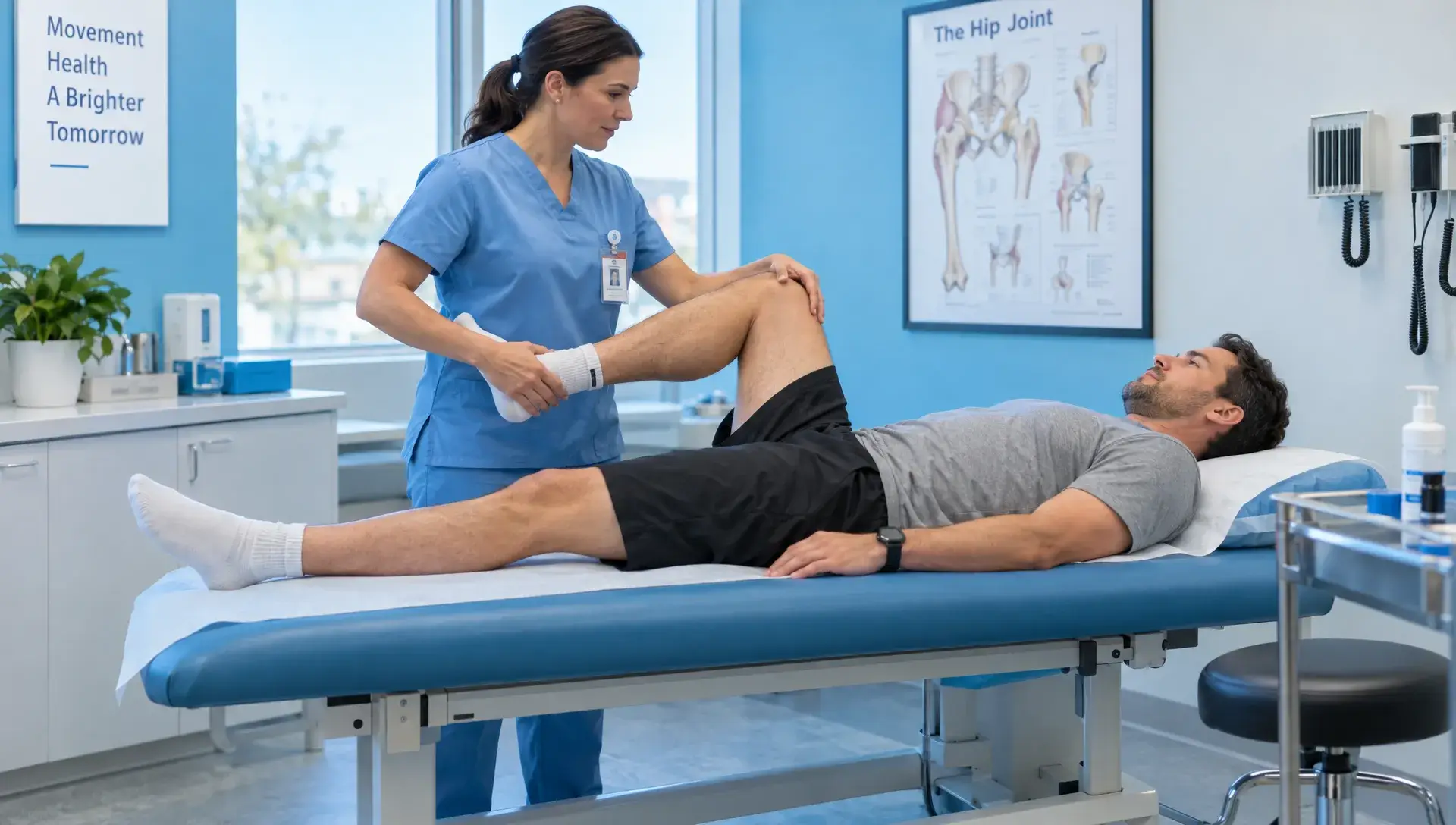
The hip examination includes walking, range of motion and movements that load the joint or surrounding muscles. Restricted internal rotation can support a hip-joint source, especially when it reproduces familiar groin pain.
Tests commonly called FADIR and FABER place the hip in specific positions to help reproduce symptoms. Their names sound definitive, but neither identifies a diagnosis on its own. Where the pain occurs during the test matters.
For outer-hip symptoms, clinicians may check tenderness over the greater trochanter, pain with resisted hip movement and tolerance of standing on one leg. They also assess the lower back because hip and spinal symptoms frequently overlap.
When X-rays, MRI or a diagnostic injection help
Imaging is most useful when it answers a specific question that could change care. It is not a substitute for examining the person.
The American College of Radiology's patient guidance on low back imaging explains why uncomplicated low back pain, with or without sciatica, often does not require imaging at the initial visit. Serious warning signs, progressive neurological findings or persistent symptoms may change that decision.
For suspected hip arthritis, X-rays can show joint-space narrowing and other bony changes. MRI may be appropriate when clinicians suspect a stress injury, certain soft-tissue problems or another condition not adequately assessed with X-rays. Suspected fracture sometimes requires further imaging even when initial X-rays appear normal.
An abnormal scan does not automatically identify the pain source. Disc changes and joint wear can exist without symptoms, so clinicians compare imaging with the history and examination.
In selected cases, an image-guided injection of local anesthetic into the hip joint can help clarify whether the joint contributes to pain. Temporary improvement supports that possibility, but the response is not perfect proof and the procedure is not necessary for everyone.
Why the distinction changes treatment
A plan for irritated spinal nerves may differ from one for hip arthritis or gluteal tendon pain. Exercises that suit one problem can aggravate another, especially when introduced too aggressively.
For suspected nerve-related pain, care may include staying active within tolerable limits, individualized exercise and monitoring strength and sensation. Persistent or worsening deficits may require specialist evaluation. Once the source is clearer, you can discuss appropriate sciatica care options rather than choosing treatment based on the label alone.
Hip-joint pain may call for strengthening, mobility work within a comfortable range and adjustments to walking or other loads. Gluteal tendon pain often requires modifying aggravating compression and gradually rebuilding load tolerance.
Chiropractic care, physical therapy, acupuncture or other pain-management approaches may form part of a plan when appropriate. The choice should reflect the likely diagnosis, your health history and measurable progress, not a promise that one technique treats every cause of hip-region pain.
How to prepare for an evaluation
Bring a short description of where the pain starts, where it travels and whether you have numbness or weakness. Note which tasks have become difficult, such as climbing subway stairs, walking several blocks or sitting through a workday. Existing imaging reports and a medication list can also help.
Avoid repeatedly provoking symptoms with online self-tests before your visit. A simple record of everyday triggers is usually more useful than forcing a painful stretch to see what happens.
Ask what the working diagnosis is, what findings support it and what would prompt a change in the plan. For cost-conscious care, request estimated visit costs, insurance details and an explanation of how any proposed imaging would affect treatment decisions.
If you run a small business, missed work can also affect company cash flow, a separate concern addressed by business advisers such as CFOLab's part-time CFO service for small businesses. Keep business budgeting separate from decisions about which tests or treatments are medically necessary.
Frequently asked questions
Can sciatica feel like hip pain without back pain? Yes. Nerve-related pain may be felt mainly in the buttock, hip region or leg. A neurological examination helps determine whether a spinal nerve is involved even when the lower back does not hurt.
Does pain below the knee always mean sciatica? No. Pain extending below the knee can support a nerve-related explanation, but hip conditions and other problems can also cause symptoms there. Sensation, strength, reflexes and movement findings help narrow the possibilities.
Can I have both sciatica and hip arthritis? Yes. The two can coexist. Clinicians look for which condition contributes most to your current limitations and reassess if treating one source leaves substantial symptoms unchanged.
Should I stretch my hip if I think I have sciatica? Do not force a stretch that sends pain farther down the leg or produces tingling, numbness or weakness. Choose comfortable movement until you receive individualized guidance, and seek prompt assessment for new neurological symptoms.
Get the back and hip assessed together
Move Well MD offers acupuncture at three Manhattan offices: Lower Manhattan, Midtown and Columbus Circle. Its Lower Manhattan office also offers chiropractic care and therapeutic exercise. A licensed medical provider offers joint and trigger point injections. If you are unsure whether symptoms come from your back, hip or both, contact Move Well MD to discuss an evaluation. Bring your symptom history and ask how the examination findings will guide the next step.
