Most people don’t “lose mobility” overnight. It’s usually a slow drift caused by long sitting, repetitive workouts, old injuries, and stress that keeps muscles guarded. A chiro wellness plan is simply a consistent weekly structure that helps you move better by combining smart mobility work, basic strength, recovery habits, and (when appropriate) chiropractic care for joint function and pain relief.
This guide gives you a simple, repeatable weekly routine you can start this week, plus ways to scale it up or down depending on your symptoms and schedule.
What “mobility” actually means (and why it feels like it’s disappearing)
Mobility is your ability to get into positions with control. It’s not just flexibility (how far you can stretch). True mobility blends:
- Joint range of motion (hips, thoracic spine, ankles, shoulders)
- Tissue tolerance (how muscles and tendons handle load and stretch)
- Nervous system safety (your body stops you from moving freely when it senses threat or irritation)
- Strength in end ranges (control at the edges, not just in the middle)
If you feel stiff in the morning, “locked up” after sitting, or limited during squats, overhead lifting, running, or even turning your head while driving, you are seeing common mobility bottlenecks.
The 5 pillars of a chiro wellness plan for mobility
A weekly routine works best when it’s built on a few pillars instead of random stretching.
1) Daily movement snacks (5 to 10 minutes)
Short, frequent movement beats one long session if you sit a lot. Think: spine, hips, ankles, and shoulders every day.
2) Mobility sessions (2 to 4 per week)
These are your focused sessions where you actually improve range of motion and control.
3) Strength that supports range (2 to 3 per week)
Mobility “sticks” better when your body is strong in the range you’re gaining.
4) Recovery inputs (sleep, walking, breathing)
If sleep is poor or stress is high, the nervous system often keeps tissues guarded.
5) Professional care when you’re stuck
If pain, joint restriction, nerve irritation, or recurring flare-ups keep blocking progress, getting assessed can save months of guessing.
Safety note: New or worsening symptoms, numbness/tingling, progressive weakness, fever, unexplained weight loss, major trauma, or bowel/bladder changes deserve urgent medical evaluation.
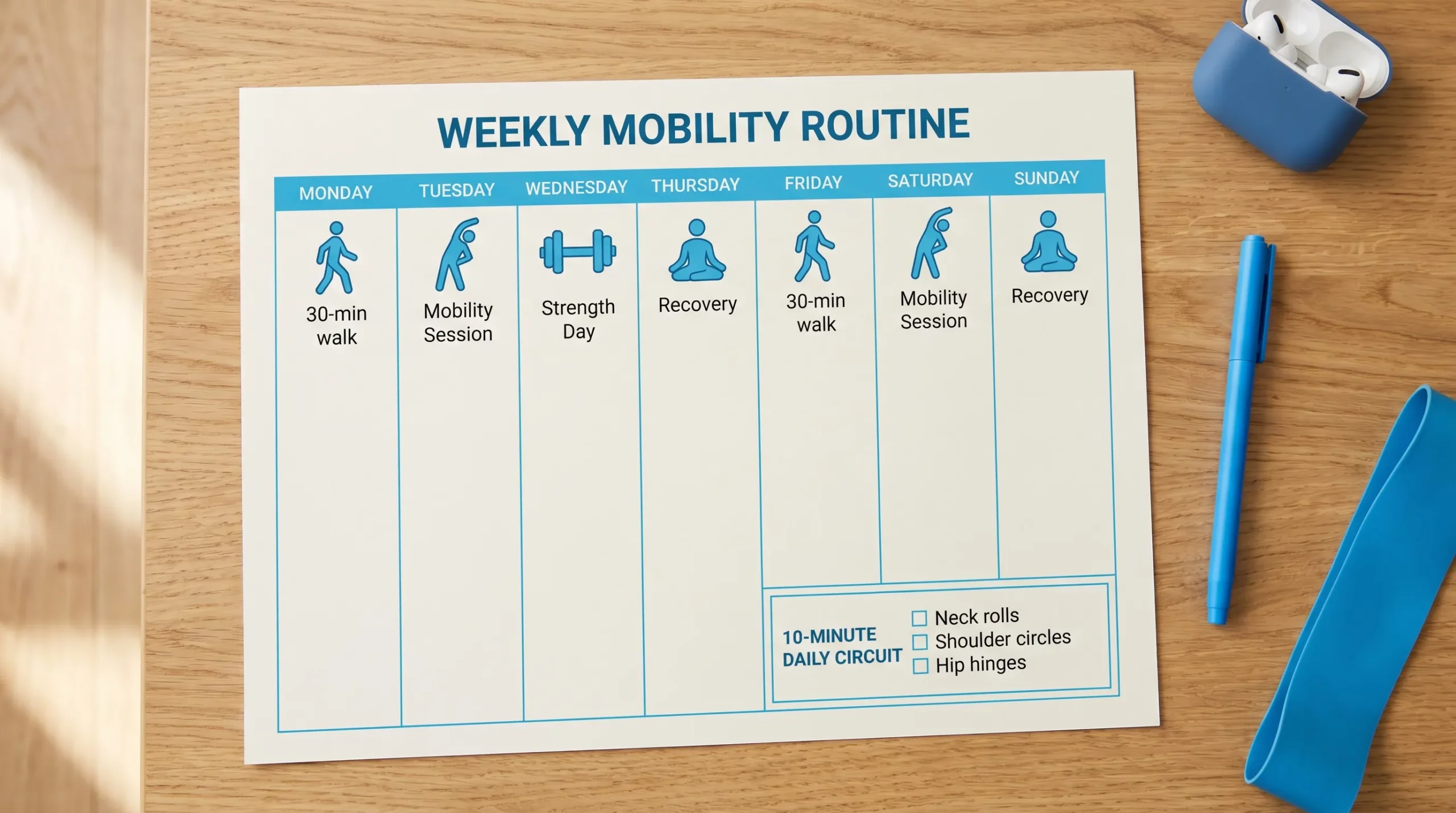
A simple weekly routine for mobility (copy this)
This plan assumes a typical NYC schedule: desk time, commuting, and limited workout windows. It’s intentionally simple.
| Day | 10-minute daily mobility | Main session (20 to 45 minutes) | Goal |
|---|---|---|---|
| Monday | Spine + hips reset | Strength (lower body + core) | Build hip control |
| Tuesday | Ankles + thoracic | Mobility session | Improve range |
| Wednesday | Neck + shoulders | Walk 30+ minutes (easy) | Recovery + circulation |
| Thursday | Spine + hips reset | Strength (upper body + carries) | Shoulder stability |
| Friday | Ankles + thoracic | Mobility session | End-range control |
| Saturday | Full-body flow | Optional sport/run + cooldown | Performance with less stiffness |
| Sunday | Easy reset | Longer walk + light stretching | Restore and prep |
How to scale it
- If you’re in pain: keep mobility daily, reduce strength volume, prioritize walking and recovery, and consider evaluation.
- If you’re active: keep daily mobility, add a third strength day, and make Saturday a performance day.
- If you’re busy: do the daily 10 minutes plus one mobility session and one strength session weekly. Consistency wins.
Your daily 10-minute mobility circuit (no equipment)
Do this once per day. If you sit a lot, do it twice (morning and late afternoon).
Part A: Spine and breath (2 minutes)
- 90/90 breathing on your back: breathe into ribs and belly, slow exhale, relax shoulders.
Part B: Thoracic spine (2 minutes)
- Open books: lie on your side, knees bent, rotate upper back gently.
Part C: Hips (3 minutes)
- Hip flexor stretch with glute squeeze: keep ribs down, squeeze back glute to avoid dumping into the low back.
- 90/90 hip switches: move slowly, use hands for support if needed.
Part D: Ankles and calves (2 minutes)
- Knee-to-wall ankle rocks: keep heel down, knee tracks over toes.
Part E: Neck and shoulders (1 minute)
- Chin tucks + gentle rotations: small range, slow control.
If any movement spikes pain above a mild discomfort, reduce range, slow down, or skip that drill for now.
Two mobility sessions per week that actually move the needle
These are 25 to 35 minutes and complement the daily circuit.
Mobility Session 1: Hips + ankles (lower body focus)
Aim: smoother squats, stairs, running, and less hip pinching.
- Controlled articular rotations (CARs): hips and ankles, slow and small-to-big
- Cossack squat prep: shift side to side in a comfortable range
- Glute bridge holds: 3 holds of 20 to 30 seconds
- Split squat iso hold (short range): 2 holds per side
- Calf eccentrics: slow lower, 6 to 10 reps per side
Mobility Session 2: Thoracic + shoulders (upper body focus)
Aim: less neck tension, better overhead position, improved posture.
- Thoracic extension on a rolled towel: gentle 6 to 8 reps
- Wall slides: keep ribs down, avoid shrugging
- Band pull-aparts (or towel isometrics): 2 sets of 10 to 15
- Scap push-ups: 2 sets of 8 to 12
- Farmer carry (if you have weights): 3 carries of 20 to 40 seconds
Where chiropractic care can fit into a wellness plan
Mobility work is powerful, but it can stall when pain and joint restriction keep returning. Chiropractic care is commonly used to address joint mechanics and reduce pain, especially for spine-related musculoskeletal issues.
For example, the American College of Physicians clinical practice guideline recommends non-drug therapies such as spinal manipulation for acute, subacute, and chronic low back pain as part of conservative care (ACP guideline).
In a practical weekly plan, chiropractic care may help when:
- You have recurring stiffness that returns quickly after stretching
- A specific movement consistently “catches” or feels blocked
- You are modifying workouts due to back, neck, or sciatic-type symptoms
- You want guidance on what to mobilize vs what to stabilize
A good approach is to pair hands-on care with a home plan so improvements don’t fade between visits.
Timing tip
Many people feel best doing light mobility the day of or the day after care, then strength training 24 to 48 hours later (depending on soreness and your clinician’s guidance).
Make the routine stick: use a weekly “minimum effective plan”
Most mobility plans fail for a simple reason: they are too complicated to repeat.
Try this rule:
- Non-negotiable minimum: 10 minutes daily + two 25-minute sessions per week
- Bonus options: extra walking, a third strength day, longer recovery on weekends
If you like no-fluff examples of how professionals turn big goals into simple weekly systems, you can borrow the same planning mindset from resources like Saaga Solve’s actionable strategy tips and apply it to your health routine (keep the plan small, track it, repeat it).
How to track progress (without overthinking it)
Mobility is easiest to measure through function, not perfection.
Pick two or three metrics for 4 weeks:
- Pain score (0 to 10): morning and end of day
- One movement benchmark: deep squat depth, hip rotation comfort, or overhead reach
- A real-life task: walking tolerance, stairs, sitting tolerance, or turning your head while driving
| Metric | How to test | Improvement you want |
|---|---|---|
| Morning stiffness | Minutes until you feel “loose” | Fewer minutes |
| Hip mobility | 90/90 position comfort | Less pinching, smoother transitions |
| Thoracic rotation | Open book range | More rotation, less rib flare |
| Walking tolerance | Minutes without flare-up | Longer time |
Common mistakes that keep people stiff
Stretching harder instead of moving smarter
Aggressive stretching can irritate tissues when the real issue is control, weakness, or nerve sensitivity.
Doing mobility only when you feel tight
Mobility responds to consistency. Random sessions are maintenance at best.
Skipping strength
Strength is what teaches the body to trust new ranges.
Ignoring sleep and stress
If your nervous system is on high alert, your body often trades mobility for protection.
When to get a personalized assessment
A weekly routine helps most people, but you should consider an evaluation if:
- Pain persists beyond 2 to 4 weeks despite consistent self-care
- You have symptoms traveling down an arm or leg
- You keep re-injuring the same area
- Your mobility limitation is one-sided and worsening
Move Well MD is a Manhattan clinic that combines chiropractic care with complementary services like acupuncture, physical therapy, and pain management. If you want a plan built around your specific mobility restrictions (not a generic template), getting assessed can clarify what to mobilize, what to strengthen, and what to stop doing for now.
Frequently Asked Questions
What is a chiro wellness plan? A chiro wellness plan is a consistent routine that combines mobility work, strength, recovery habits, and chiropractic care when appropriate to support movement quality and reduce pain.
How often should I do mobility work each week? For most people, daily 10-minute mobility plus two longer mobility sessions per week is a strong baseline. Add more only if recovery is good and symptoms are stable.
Is mobility better before or after a workout? Light mobility is often best before training (to prepare joints) and a short cooldown after (to restore range). Longer mobility sessions can be done on non-lifting days.
Can chiropractic care improve mobility? It can, especially when restricted joint motion and pain are limiting movement. Results tend to last longer when paired with targeted exercises and habit changes.
What if stretching makes me feel worse? Back off intensity, reduce range, slow down, and prioritize controlled mobility and gentle walking. If symptoms persist or include numbness/weakness, seek evaluation.
Ready to build a mobility plan that fits your body?
If you are tired of guessing which stretches to do (or why your stiffness keeps coming back), consider getting a personalized plan.
Move Well MD offers integrated chiropractic care and acupuncture in Manhattan with a focus on pain relief and getting you back to moving confidently. Learn more or schedule a visit at Move Well MD.
