Medically reviewed by Ben Gruen, DC, Chiropractor
Searching for a “knee chiropractor near me” can be a reasonable starting point for nonurgent knee discomfort, but some symptoms need a different appointment. A chiropractor should recommend medical or orthopedic evaluation when the examination suggests a significant injury, an unexplained joint problem or pain that is not improving with appropriate conservative care.
Some findings call for a routine orthopedic referral. Others require same-day medical care or an emergency department, not another treatment session. Knowing the difference can help you avoid delayed diagnosis and paying for care that does not address the problem.
When Knee Pain Needs Urgent Medical Care
A referral is not always a letter to an orthopedist followed by a weeks-long wait. When a knee problem could threaten the joint, circulation or general health, the priority is timely medical assessment.
| Finding | Appropriate next step |
|---|---|
| A visibly deformed knee after injury, an open wound over a suspected fracture or a cold, pale or numb foot | Emergency department now |
| A hot, swollen knee with fever, chills or feeling unwell | Same-day urgent medical evaluation, often in an emergency department |
| Inability to bear weight after injury, rapid major swelling or a knee that becomes physically stuck | Urgent assessment, generally the same day |
| New one-sided calf swelling or pain, especially after surgery or prolonged immobility | Urgent medical assessment for a possible blood clot |
| Leg symptoms accompanied by sudden breathlessness, chest pain or fainting | Call 911 |
The NHS guidance on knee pain identifies inability to bear weight, significant swelling, deformity and a hot knee with fever as reasons to seek urgent help. Infection can sometimes occur without fever, particularly in people with weakened immune systems. New warmth and swelling after knee surgery, an injection or a joint replacement also deserve prompt assessment.
A “knee chiropractor near me” search should not delay this care. Avoid forceful manipulation or trying to push a locked or deformed knee back into position while arranging evaluation.
Signs That an Orthopedic Referral Is Appropriate
An orthopedist evaluates bone, cartilage, ligament and tendon conditions. Seeing one does not automatically mean surgery. The visit may clarify the diagnosis, guide rehabilitation or identify whether a procedure is worth considering.
Locking, Instability or a Significant Injury
A knee that catches occasionally is different from one that becomes physically blocked and cannot straighten. True locking can occur with a displaced meniscus tear or a loose fragment inside the joint and warrants prompt evaluation.
A twisting injury followed by a pop, rapid swelling or repeated giving way also raises concern for structural damage. Inability to actively straighten the knee or lift the straight leg after an injury needs urgent assessment for a possible tendon injury or fracture.
These findings are reasons to investigate, not proof of a particular diagnosis. Pain and swelling can make the initial examination difficult, so follow-up examination or imaging may be necessary.
When comparing results for “knee chiropractor near me,” look for a clinician who distinguishes ordinary soreness from mechanical symptoms rather than assuming every painful knee needs adjustment.
Persistent Swelling or Increasing Limitations
Recurring joint swelling deserves an explanation, especially when it returns without a clear activity-related trigger. Progressive loss of motion, repeated buckling or increasing difficulty with everyday walking can justify orthopedic assessment even without a dramatic injury.
For knee osteoarthritis, referral becomes more useful when pain and functional limitations remain unacceptable despite an appropriate nonsurgical plan. Decisions should account for your symptoms, examination, medical history and goals, not an X-ray description alone.
Unexplained night pain, weight loss, prolonged morning stiffness or several swollen joints may require primary care or rheumatology evaluation instead. A responsible referral goes to the clinician best suited to the suspected problem, not automatically to an orthopedic surgeon.
What the Chiropractor Should Check Before Treating Your Knee
A useful assessment starts with how the problem began. A sudden sports injury, gradual pain on stairs and swelling after a recent procedure suggest different priorities.
The clinician should ask about previous injuries, surgery, joint replacement, medications and relevant medical conditions. Blood thinners, osteoporosis, inflammatory arthritis and immune suppression can change the level of concern and the safety of treatment.
The examination may assess walking, swelling, tenderness, range of motion, strength and stability. Sensation and circulation matter when symptoms suggest nerve or blood vessel involvement. The hip, ankle and lower back may also need evaluation because pain can be referred to the knee or influenced by movement elsewhere.
Before choosing a provider from a “knee chiropractor near me” search, ask: “What findings would make you stop treatment and refer me?” The answer should be specific enough to include significant injury, concerning swelling, worsening function and lack of meaningful progress.
You should leave with a working explanation, any remaining uncertainty and a plan for resolving it. A confident label without an adequate examination is not a substitute for diagnosis.
Imaging Should Answer a Specific Clinical Question
Not every painful knee needs an MRI. Imaging decisions depend on the injury mechanism, examination findings, symptom duration and what the result would change.
For persistent knee pain, X-rays are commonly the initial imaging test when imaging is indicated. They can show fractures, joint-space changes and certain other bone abnormalities. They do not directly show a meniscus tear.
MRI can help evaluate menisci, ligaments, cartilage and other soft tissues when the clinical situation warrants it. The American College of Radiology’s chronic knee pain criteria support a staged approach rather than routine MRI for every patient.
Neither an MRI abnormality nor an arthritis finding automatically explains all of your pain. Results must be interpreted alongside symptoms and function. Conversely, reassuring imaging does not rule out every important cause of a hot or swollen joint.
A provider found through “knee chiropractor near me” should be able to explain why a proposed test is needed, who will interpret it and how it could change your care. Blanket imaging packages are not the same as individualized evaluation.
When Conservative Care Is Reasonable
For selected nonurgent knee conditions, a conservative plan may include activity modification, progressive strengthening, mobility work and rehabilitation. Manual treatment may be an adjunct when appropriate, but its suitability and likely benefit depend on the diagnosis.
Chiropractic manipulation cannot reconnect a ruptured ligament, remove a loose fragment or treat a joint infection. It should not replace indicated medical care. For a broader discussion of suitable approaches, see how chiropractic care may help some types of knee pain.
A meniscus tear does not always require an operation. The American Academy of Orthopaedic Surgeons’ meniscus guidance describes both nonsurgical and surgical options, depending on factors such as the tear and symptoms. Persistent locking or other concerning findings change that discussion.
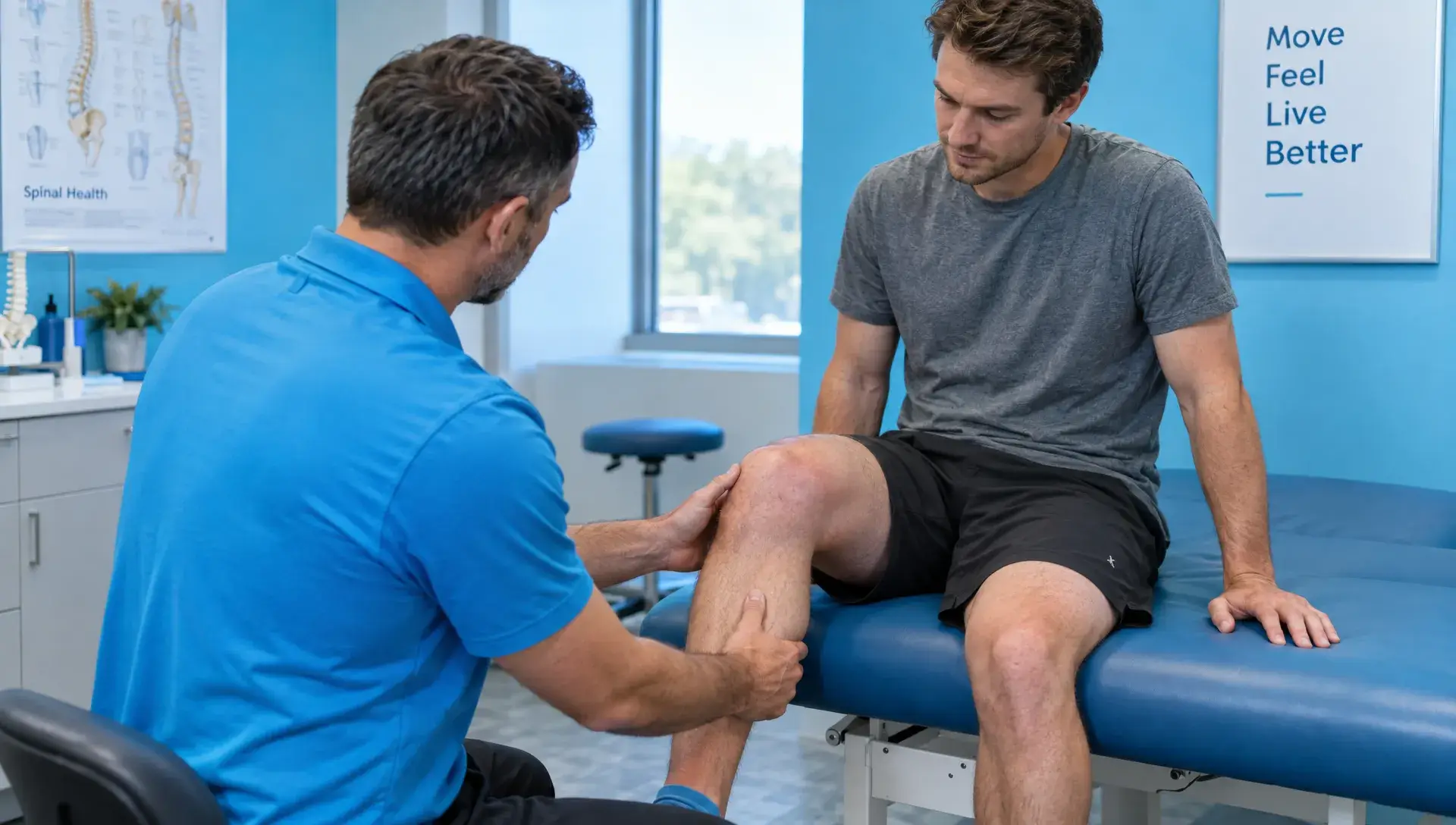
Progress Needs a Review Point
Before treatment starts, agree on practical goals: walking farther, managing subway stairs, straightening the knee more comfortably or returning to a modified workout. Track function and swelling as well as pain.
There is no universal number of chiropractic visits that every knee needs before referral. The review point should match the suspected condition and its severity. New locking, increasing swelling, repeated giving way or worsening ability to walk should trigger earlier reassessment.
If a reasonable trial produces no meaningful improvement, reconsider the diagnosis and treatment plan rather than simply repeating the same sessions. Temporary relief immediately after treatment does not necessarily mean the underlying problem is improving.
What a Useful Orthopedic Referral Should Include
Finding a clinician through “knee chiropractor near me” is only the beginning; continuity matters if you need another provider. A useful referral gives the orthopedist enough information to understand the concern and avoid unnecessary duplication.
The referral should summarize when symptoms began, any injury mechanism, examination findings and changes in walking or daily activities. It should also identify treatment already tried, your response and any relevant imaging or reports.
The reason for referral should be explicit, such as persistent swelling after a twisting injury, suspected instability or disabling pain despite rehabilitation. “Knee pain” alone provides little direction.
Ask who will arrange the appointment and whether it should happen urgently. If the recommended specialist cannot see you within the advised timeframe, contact the referring clinician about another route. Worsening symptoms may require a more urgent setting.
Whether rehabilitation continues while you wait depends on the suspected problem. Gentle exercise may remain appropriate in some cases, while a possible fracture or unstable injury requires protection and medical guidance first.
Choosing Care in Manhattan Without Paying for the Wrong Plan
Convenience matters when knee pain makes commuting difficult, but proximity should not outweigh clinical judgment. Check New York licensure, experience with knee conditions and willingness to coordinate with medical specialists.
If you are using “knee chiropractor near me” to compare Manhattan practices, ask about the initial evaluation fee, insurance participation and the cost of any recommended follow-up services. Confirm benefits with your insurer because coverage can differ between chiropractic care, physical therapy, imaging and specialist visits.
Be cautious about committing to a large prepaid treatment package before the diagnosis and review plan are clear. Ask what happens financially if the examination shows that you need a referral instead of treatment.
A practical framework for choosing a chiropractor can help you compare providers beyond appointment availability. The goal is appropriate care with a clear purpose, not simply the lowest price per visit or the longest proposed treatment plan.
Frequently Asked Questions
Can a chiropractor adjust a painful knee? Some chiropractors use joint mobilization or manipulation for selected knee complaints. Whether it is appropriate depends on the diagnosis and examination. Suspected fracture, infection, significant instability or a mechanically locked knee requires medical assessment rather than forceful treatment.
Should I see an orthopedist before a chiropractor? Seek urgent medical care first for warning signs. For a substantial injury, recurrent instability, persistent locking or advanced functional limitations, orthopedic assessment may be the better starting point. Nonurgent discomfort without those findings may be suitable for an initial conservative-care evaluation.
Does an orthopedic referral mean I need surgery? No. An orthopedist may recommend rehabilitation, activity changes, medication or other nonsurgical options. Surgery is considered according to the diagnosis, symptom severity, treatment response and your preferences.
What should I ask when calling a local clinic? After a “knee chiropractor near me” search, ask whether the clinician evaluates knee injuries, how urgent symptoms are screened and when they refer to orthopedics. Also ask about evaluation costs and whether treatment recommendations follow the examination rather than a predetermined package.
Should I keep exercising while waiting for an appointment? Avoid activities that cause giving way, sharp pain or increased swelling. Do not force a locked knee. Weight-bearing limits and exercise choices depend on the suspected injury, so seek individualized guidance, especially after trauma or when walking is difficult.
Discuss the Right Starting Point for Your Knee Pain
Move Well MD offers acupuncture at three Manhattan offices: Lower Manhattan, Midtown and Columbus Circle. Its Lower Manhattan office also offers chiropractic care and therapeutic exercise. A licensed medical provider offers joint and trigger point injections. If your symptoms are nonurgent, contact Move Well MD to discuss a knee evaluation and ask which service may fit your situation.
Describe any injury, swelling, locking or difficulty bearing weight when you call. If you have urgent warning signs, seek medical care now rather than waiting for a routine appointment.
